
Corrugated Fluting: Basics, Types and Uses
Corrugated is widely used for packaging because it can combine product protection, practical handling, and competitive cost. According to AF&PA, 70% to 75% of the cardboard available for recovery in the United States was recycled in 2025.
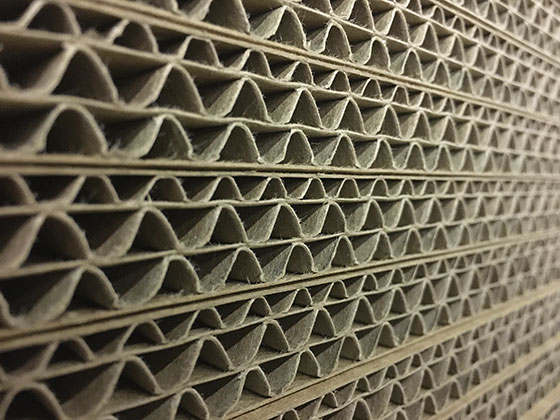
Single-wall corrugated board is made from three paper layers: an outer liner, an inner liner, and a fluted middle layer. The fluting, also called the “medium,” is the arched layer between the liners. This design gives the material its strength.
Fluting size affects the box’s durability, weight, and cost. It also affects print quality.
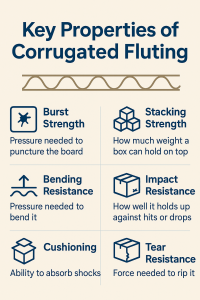
Key Properties of Corrugated Fluting
Burst strength: Pressure needed to rupture (burst) the board
Stacking strength: How much weight a box can hold on top
Bending resistance: Pressure needed to bend it
Impact resistance: How well it holds up against hits or drops
Cushioning: Ability to absorb shocks
Tear resistance: Force needed to rip it
Larger flutes generally provide more cushioning, while smaller flutes provide a smoother printing surface. Strength, weight, and cost also depend on the papers and board construction.
Flute Size Overview
One way corrugated is classified is based on flute size. There are several different sizes of fluting. Flute size affects cushioning and printability, but it does not determine strength, weight, or cost by itself. Smaller flutes also provide a better printing surface when compared to larger flutes. This is because there are more flutes per linear foot which creates a more rigid, smooth, and consistent surface for printing.
Each corrugated fluting size has its own function and features. Below is an overview of each flute size, highlighting some of its properties. You can also check out our packaging resource charts for some additional visuals. The thicknesses below are nominal trade sizes; actual board thickness varies by mill, flute profile, and liner weight.
A Flute: 1/4″ Thick (33 flutes/ft)
The largest flute profile among the A, B, C, and E sizes covered here. A flute corrugated provides an abundance of strength, cushioning, and impact resistance. A flute can be used for large items that need cushioning and impact protection, but it is not very common and minimum order quantities may apply. C, B, and E are by far the most common flute options we work with.
C Flute: 3/16″ Thick (39 flutes/ft)
The most common flute size as it has a great balance between cost and performance. Even though it is not the thickest flute size, it still provides adequate strength and impact-resistance for most applications. C flute also has a better surface for printing than A flute. C flute is commonly used for regular slotted containers because it offers a useful balance of cushioning, stacking performance, and printability.
B Flute: 1/8″ Thick (47 flutes/ft)
The “Jack of all trades, master of none” of the corrugated industry. B flute offers a useful balance of cushioning, board thickness, and printability. B flute provides a good printing surface, however, E flute would be superior. That being said, B flute is PAX Solutions’ favorite flute because of its flexibility and above-average performance.
E Flute: 1/16″ Thick (90 flutes/ft)
One of the thinner flute options. Using the nominal sizes listed here, E flute is about one-third the thickness of C flute. Its thinner profile can reduce storage space. E flute also provides great printability as the small flutes help keep the board straight for consistent printing. E flute is best used for packaging smaller, light-weight items that are not easily breakable.

Choosing the Right Flute
Each flute type serves a different purpose. For shipping, choose the flute and board grade based on the product and handling requirements. For printed retail boxes, E flute is often a good option. B flute is a solid all-round option. Flute selection is one part of the full spec for custom corrugated boxes, along with board grade and box style.
Need help picking the right one? Contact PAX Solutions. We’ll help you find what works.
@pax.solutions Have you heard of the Edge Crush Test? #packaging #strength #board #stack #power
♬ original sound - pax.solutions