

If you have spent any time sourcing custom packaging labels, you already know that “just a label” is never just a label. The substrate you choose affects how your product looks on the shelf, how it performs in the field, and whether it survives shipping, cold storage, sterilization, or a client’s hands. The wrong material choice can mean labels that peel, smear, crack, or fail an audit.
This guide breaks down the most common custom packaging label materials, when each one makes sense, and what questions to ask before committing to a run.
Why Material Selection Matters With Custom Packaging Labels
A label does more than identify a product. It communicates brand quality, carries regulatory information, and in many industries, serves as part of the compliance record. For medical device packaging, for example, labels often need to survive ethylene oxide (EO) sterilization, maintain adhesion through temperature swings, and remain legible through the product’s shelf life. Choosing the wrong substrate in that context is not just an aesthetic problem. It is a quality system failure.
Even outside regulated industries, the cost of a bad material choice adds up fast. Short-run reprints, returns, and relabeling eat margin quickly. Getting the spec right the first time is almost always cheaper than fixing it later.
The Most Common Custom Label Materials
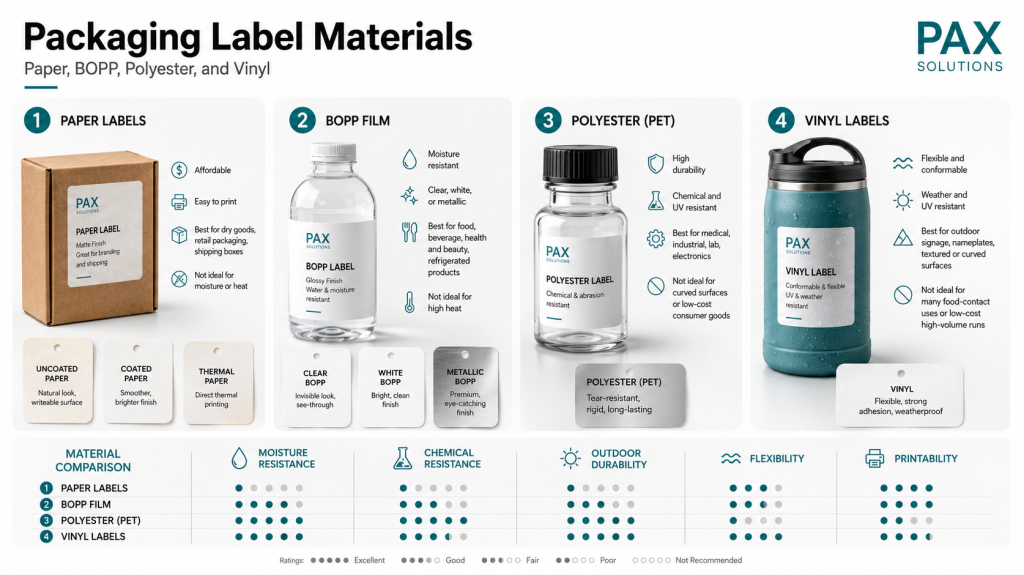
1. Paper Labels
Paper is the most widely used label substrate and the most affordable. It accepts ink well, is easy to print on, and works for a wide range of applications where moisture, abrasion, and temperature extremes are not a concern.
Common paper types include:
- Uncoated paper – matte finish, natural look, often used for artisan or kraft-style packaging
- Coated paper (gloss or matte) – smoother surface for sharper image quality, slightly more durable
- Thermal paper – used for direct thermal printing (no ribbon required); common in shipping and retail. These labels are often used with Zebra Printers.
Best for: dry goods, retail packaging, corrugated shipping boxes, light-duty product labels, short shelf life items
Not ideal for: moisture exposure, outdoor use, high-heat environments, or products that need to be wiped down
2. BOPP (Biaxially Oriented Polypropylene) Film
BOPP is one of the most popular materials for consumer product labels, particularly in food and beverage. It is a flexible plastic film that resists moisture, oils, and mild chemicals, and it holds up far better than paper in humid or refrigerated environments.
BOPP is available in clear, white, and metallic finishes. Clear BOPP on a clear bottle creates a no-label look that many brands use intentionally. White BOPP mimics the appearance of a paper label while offering significantly better durability.
Best for: water bottles, food packaging, health and beauty products, household goods, refrigerated or frozen products
Not ideal for: high-heat applications, chemical exposure beyond mild resistance, or rigid surfaces with significant contour
3. Polyester (PET) Labels
Polyester labels offer exceptional durability. They resist tearing, chemicals, UV exposure, and a wide temperature range. Where BOPP is flexible and somewhat conformable, polyester is more rigid and dimensionally stable, which makes it a better choice for precision applications where the label cannot shift, stretch, or distort.
Polyester is common in industrial and medical settings where labels need to remain intact and legible through harsh processing conditions.
Best for: medical device labeling, industrial equipment, laboratory samples, outdoor products, chemical containers, electronics
Not ideal for: curved or highly contoured surfaces, cost-sensitive consumer goods where polyester’s premium pricing is hard to justify
4. Vinyl Labels
Vinyl is the go-to material for applications that require high conformability, outdoor UV resistance, and long service life. It stretches over curves and irregular surfaces without cracking and holds up well against weathering.
Best for: outdoor signage, equipment nameplates, tooling labels, promotional labels, curved or textured surfaces
Not ideal for: food contact applications (check specific product compliance), high-volume short-run consumer goods where cost is a constraint
The materials listed above are some of the most common custom packaging labels material. For more material options, check out our “custom labels” page on our website.
Adhesive Matters Too
The substrate is only half the story. The adhesive beneath it determines how a label bonds to a surface, whether it can be removed cleanly, and how it performs across temperatures.
Permanent adhesive – bonds aggressively and is not intended for removal; the standard choice for most applications
Removable adhesive – allows clean removal without leaving residue; useful for promotional labels, pricing, or products where end users need to reapply or remove the label
Freezer-grade adhesive – formulated to bond at low temperatures; required for frozen food packaging and cold storage
High-tack adhesive – designed for low-energy surfaces like certain plastics, textured materials, or powdery substrates that standard adhesives struggle to grip
Aggressive permanent adhesive – used on rough, porous, or difficult surfaces like corrugated, wood, or recycled content cartons
One of the most common label failures is pairing the right substrate with the wrong adhesive for the surface or environment. Always confirm both when specifying a label.


Finishes and Coatings
Once you have the substrate and adhesive, finish options further affect appearance, feel, and performance:
- Gloss laminate – high shine, adds scuff resistance and moisture protection
- Matte laminate – non-reflective, premium tactile feel, scratch resistant
- Soft-touch laminate – velvety feel, associated with premium or luxury branding
- UV coating – protects against fading and weathering, available in spot or flood formats
- Varnish – lighter protective coat than laminate, available in gloss or matte
Lamination and coating add cost but often extend label life enough to be worth it, particularly for products with long shelf lives or harsh environments.
If you would like more information on the formation of custom labels, please check out our blog.
Questions to Ask Your Label Supplier
Before requesting a quote on custom packaging labels, be ready to answer:
- What surface is the label being applied to, and is it curved?
- What environment will the label be exposed to (temperature, moisture, UV, chemicals)?
- Does the label need to survive any processing steps (sterilization, freezing, autoclaving)?
- Is removability required at any point in the product’s life?
- Are there any regulatory or compliance requirements for the label or its materials?
- What printing process will be used, and what finishing is desired?
- What is the required shelf life of the label in use?
Getting specific on these points upfront prevents costly reprints and material changes down the line.
If you are working through a label specification and want a second set of eyes, please contact PAX Solutions. Getting the substrate, adhesive, and finish combination right the first time saves time, reduces waste, and protects your brand on the shelf and in the field.