

Specifying the wrong foam material leads to crushed products, failed drop tests, and costly redesigns. The challenge is that foam packaging spans dozens of formulations, each with distinct mechanical properties that determine whether your product arrives intact or damaged. This technical comparison covers the five most common foam types: EPS vs EPE vs EVA, PU, and XLPE. You can also read more about the foam packaging we offer on our foam packaging page.
Understanding Foam Cell Structure: Open vs Closed Cell
Before comparing specific materials, it helps to understand the fundamental distinction between open-cell and closed-cell foams. Open-cell foams have interconnected air pockets that allow air and moisture to pass through. This structure provides excellent cushioning and conformability but offers limited moisture resistance. Closed-cell foams trap gas within individual cells, creating a denser material with better moisture barriers, higher firmness, and improved compression recovery.
Most protective packaging applications favor closed-cell foams because they maintain their cushioning properties over repeated impacts and don’t absorb moisture during shipping. However, open-cell options like polyurethane serve specific applications where soft conformability and vibration dampening matter more than moisture resistance.
EPS (Expanded Polystyrene): The Cost-Effective Commodity Option
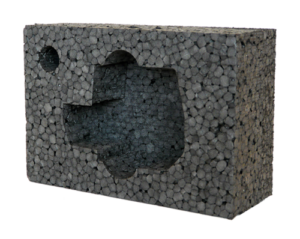
EPS is the white, bead-molded foam familiar from appliance packaging and coolers. It is commonly known as Styrofoam. It’s manufactured by expanding polystyrene beads with steam, then fusing them in molds to create custom shapes.
Technical Specifications:
- Cell structure: Closed cell (bead-molded)
- Density range: 0.9–2.0 lb/ft³
- Compression recovery: Poor (15–30% permanent set after compression)
- Operating temperature: -40°F to 165°F
- Moisture absorption: Low (1–4% by volume)
Commonly Available Colors:
- White
- Black
Best applications: EPS excels in single-use, high-volume packaging where cost is the primary driver. Appliances, consumer electronics, and temperature-sensitive shipments (as insulated shippers) represent its core use cases. Its moldability allows complex geometries at low tooling costs.
Limitations: EPS is brittle and doesn’t recover well from compression, making it unsuitable for reusable packaging or applications requiring multiple impact protection. It generates static electricity (problematic for electronics without additional ESD treatment) and breaks into small beads that create debris. Many sustainability programs also restrict EPS due to recycling challenges.

EPE (Expanded Polyethylene): Lightweight Protection for Sensitive Surfaces
EPE is a closed-cell, bead-expanded polyethylene foam that offers better resilience than EPS while remaining lightweight. It’s commonly produced in sheets, planks, or molded shapes.
Technical Specifications:
- Cell structure: Closed cell (bead or extruded)
- Density range: 1.2–2.2 lb/ft³
- Compression recovery: Good (75–85% recovery after 50% compression)
- Operating temperature: -40°F to 180°F
- Moisture absorption: Very low (<1%)
Commonly Available Colors:
- White
- Black
Best applications: EPE provides Class A surface protection, meaning it won’t scratch powder-coated metals, painted surfaces, or polished finishes. This makes it ideal for automotive components, appliance panels, and any product where surface quality is critical. Its light weight also helps minimize dimensional weight charges in parcel shipping.
Limitations: EPE offers less firmness than crosslinked foams, so heavy products may bottom out during impact. It’s best suited for light to medium-weight items where cushioning matters more than structural support. For a closer look at EPE applications, visit our packaging gallery.
EVA (Ethylene Vinyl Acetate): Premium Feel with Superior Resilience
EVA is a closed-cell foam copolymer that combines the toughness of polyethylene with the flexibility of vinyl acetate. The result is a soft, rubbery material with excellent impact absorption and a premium tactile quality.
Technical Specifications:
- Cell structure: Closed cell
- Density range: 2.0–6.0 lb/ft³
- Compression recovery: Excellent (85–95% recovery)
- Operating temperature: -40°F to 150°F
- Moisture absorption: Very low (<1%)
Commonly Available Colors:
- White
- Black
- Gray
- Blue
Best applications: EVA dominates in tool cases, sporting goods, camera equipment, and any application where users interact directly with the foam. Its soft, resilient feel communicates quality, and it withstands repeated compression cycles without degrading. Medical device packaging and presentation cases frequently specify EVA for these reasons.
Limitations: EVA costs more than EPE or EPS, which limits its use to applications where the premium feel justifies the expense. Some EVA formulations can off-gas initially, which may be a concern for sensitive electronics or enclosed storage. Its lower temperature ceiling (150°F) also restricts use in high-heat environments.

PU (Polyurethane): Open-Cell Cushioning for Delicate Products
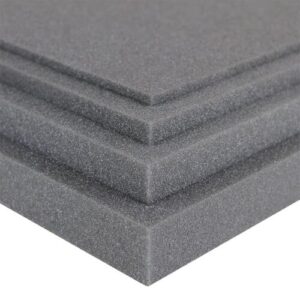
Polyurethane foam is the familiar spongy material in furniture cushions. It serves packaging applications where soft conformability matters. Its open-cell structure allows it to compress easily and wrap around irregular shapes.
Technical Specifications:
- Cell structure: Open cell (typically)
- Density range: 1.0–3.0 lb/ft³
- Compression recovery: Good (varies widely by formulation)
- Operating temperature: -40°F to 200°F
- Moisture absorption: High (open cells absorb water and humidity)
Commonly Available Colors:
- White
- Black
- Gray
- Blue
Best applications: PU works well for vibration dampening, cushioning delicate instruments, and protecting surfaces that require soft, non-abrasive contact. Its conformability makes it effective for irregularly shaped products. Different density grades allow engineers to match firmness to product weight. Learn more about foam insert options on our foam packaging page.
Limitations: The open-cell structure means PU absorbs moisture and collects dust over time, making it less suitable for long-term storage or humid environments. It also doesn’t provide the firm support needed for heavy products. For applications requiring both cushioning and moisture resistance, closed-cell alternatives typically perform better.
XLPE (Crosslinked Polyethylene): The Performance Standard for Critical Applications
XLPE undergoes a chemical or irradiation process that crosslinks its molecular chains, creating a denser, more uniform foam with superior mechanical properties. It represents the premium tier of polyethylene foams.
Technical Specifications:
- Cell structure: Closed cell (fine, uniform cell structure)
- Density range: 2.0–6.0 lb/ft³
- Compression recovery: Excellent (90–98% recovery)
- Operating temperature: -40°F to 200°F
- Moisture absorption: Extremely low (<0.5%)
- Chemical resistance: Ozone, UV, and most solvents
Commonly Available Colors:
- White
- Black
- Gray
- Blue
- Red
- Yellow
Best applications: Medical devices, precision instruments, aerospace components, and reusable cases specify XLPE because it maintains consistent cushioning properties over years of use. Its smooth, clean appearance also elevates presentation quality for luxury products and sales kits. The fine cell structure provides Class A surface protection comparable to EPE but with greater firmness and durability.
Limitations: XLPE commands a premium price, often 2–3x the cost of standard PE foams. For single-use packaging or cost-sensitive applications, this expense rarely justifies the performance gains. It also requires more specialized fabrication equipment for complex geometries.

Selecting the Right Foam: A Decision Framework
Foam selection comes down to four variables: product weight and fragility, surface sensitivity, reuse requirements, and budget. For heavier parts, choose a stiffer closed-cell grade and sufficient density to avoid bottoming out. EVA and XLPE are common options. For painted, polished, or cosmetic surfaces, use Class A closed-cell foams such as EPE or XLPE to reduce scuffing and abrasion. If you plan to reuse the packaging, prioritize high compression recovery and dimensional stability like EVA or XLPE. If your budget is the driving factor in your decision-making process, then you may want to start with EPS (Styrofoam).
No matter what you end up choosing, we always recommend testing the foam to make sure it can hold up to your standards. Even with correct material selection, factors like product geometry, drop height, and temperature cycling affect real-world performance. ISTA or ASTM testing protocols verify that your foam design protects products through actual distribution conditions.
Choosing the Right Foam for Your Application: EPS vs EPE vs EVA
Each foam fits a distinct performance and cost tier. EPS targets low-cost, single-use packaging. EPE adds better rebound and Class A surface protection at a mid-range price. EVA delivers a softer, premium feel with strong resilience for cases, kits, and presentation packaging. PU provides gentle cushioning and high conformability for delicate parts and irregular shapes, with higher moisture sensitivity due to its open-cell structure. XLPE provides the highest consistency, tightest cell structure, and best long-term recovery for reusable systems and demanding sectors such as medical devices and aerospace.
Choose based on your requirements across your distribution environment, not unit material cost alone. Match foam type, density, thickness, and fit to product weight, fragility, surface sensitivity, reuse goals, and exposure to humidity, vibration, and temperature swings.
Contact our team to discuss which foam material aligns with your product’s weight, fragility, surface requirements, and budget.